Big J goes to her real wars
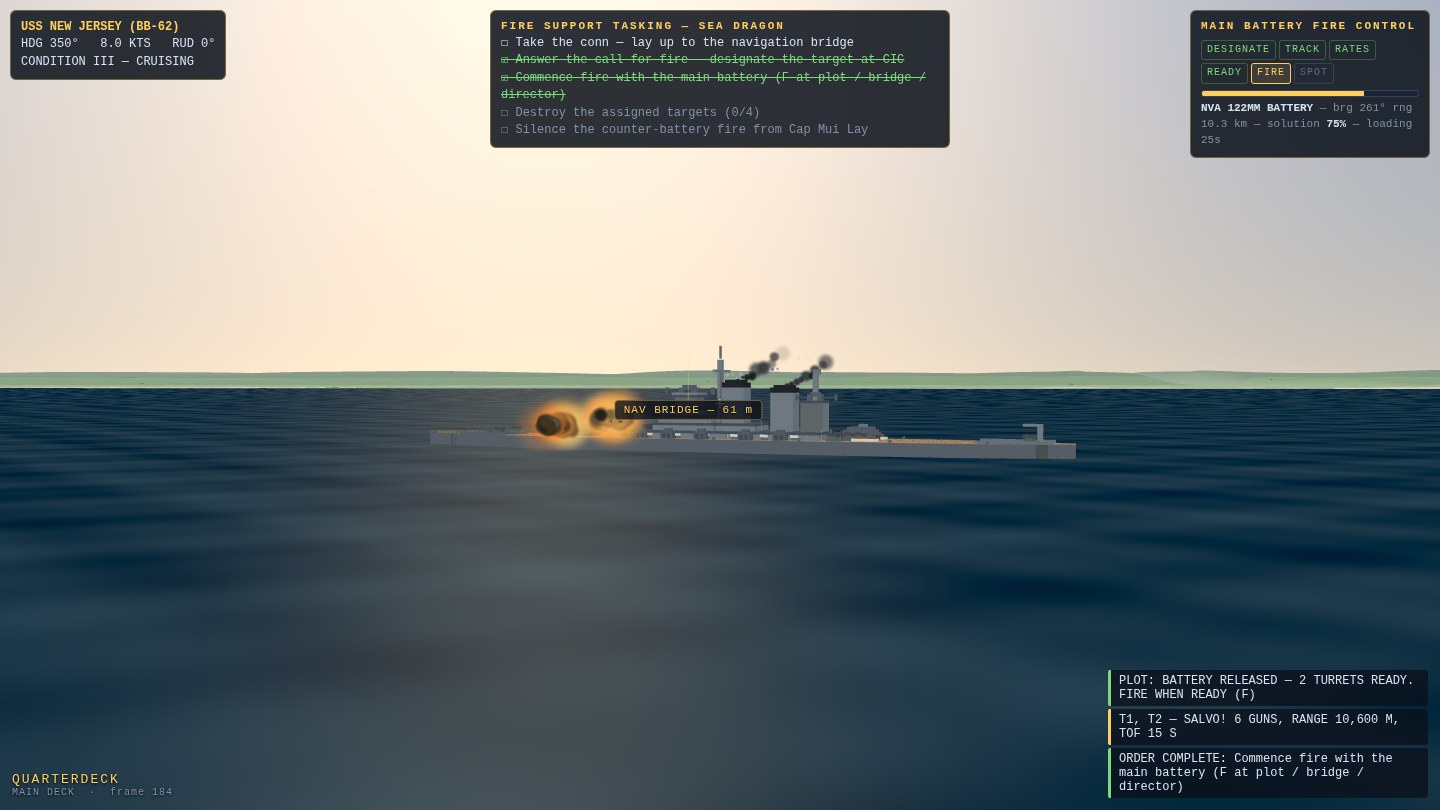
The walkable USS New Jersey shipped with a fictional 1944 gun duel — the fight the Iowas trained for and never got. But the Big J did shoot in anger, twice, and neither time at a ship. The battleship page now opens on a mission select: the what-if surface action, the Vietnam gunline of 1968–69, and Beirut in February 1984. The new ones needed a whole mechanic the game didn't have: shore bombardment.

Land the shells can hit
Shore fire needs a shore. Each historical mission raises a real coastline — and it's the same land the radar paints, the same land your targets sit on, and the same land your shells strike. Off the DMZ it's a beach berm, paddy plain and jungle foothills with the Cua Viet cutting through; off Beirut it's the city's narrow shelf and the Shouf mountains stacking up to a February snow line. A 16-inch round flies its arc all the way out and bursts in a climbing column of earth exactly on the hillside you were looking at through the director's optics.
A spotter on the net
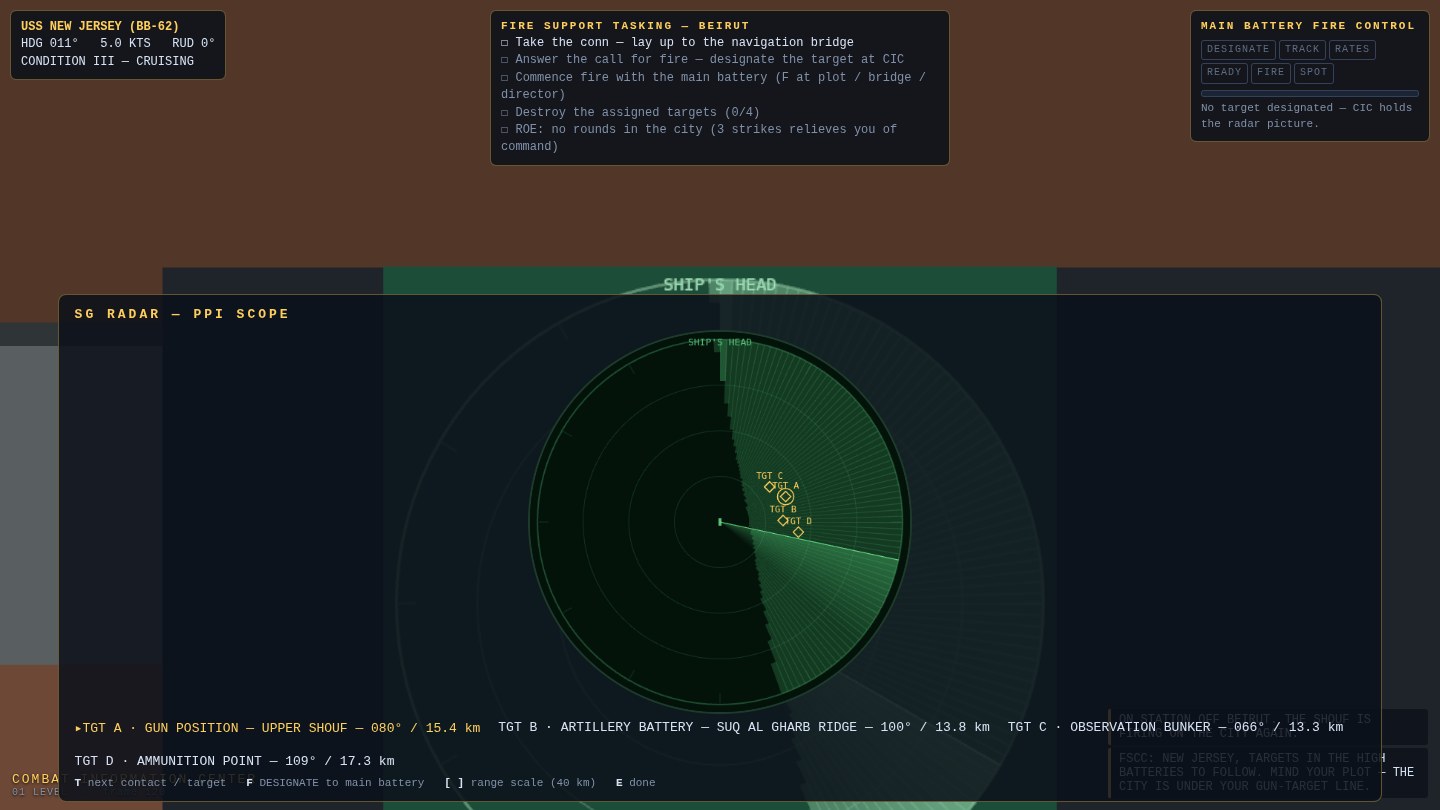
There's no enemy fleet out here, so CIC works for someone ashore. A spotter — ANGLICO callsign LEATHERNECK 2-6 in Vietnam, the Fire Support Coordination Center off Beirut — calls fire missions over the net: target, description, bearing, range. Called targets appear on the radar scope as hand-plotted gold diamonds beside the painted coastline, and you hand them off to the main battery exactly like any other contact — same rangekeeper, same firing solution. The spotter talks you on in his own language — ADD 200, RIGHT 100 instead of the naval OVER and SHORT — and reads back battle damage when the target dies: guns silent, pits burning, end of mission, out.
They shot back, so we do too
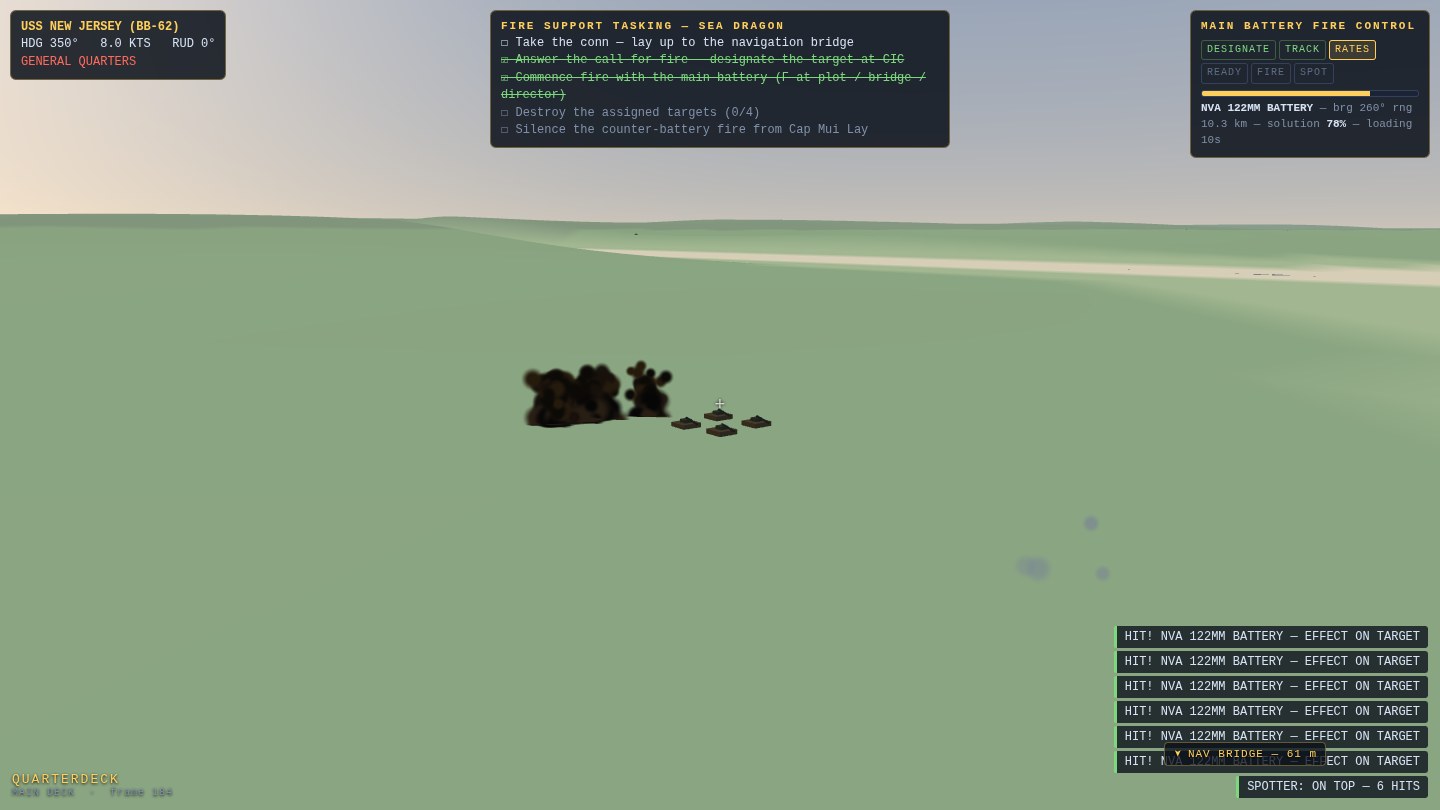
New Jersey was taken under fire repeatedly on the gunline — coastal guns near Cap Mui Lay straddled her more than once and never touched her. So: fire your first salvo in the Vietnam mission and the coastal battery unmasks, counter-battery radar plots the flashes, and 130 mm rounds start arriving with a whistle. They fly and hit the same way every shell does, the splinter threat they really were — the Big J's armor treats them with period-honest contempt, but a lucky one landing topside can still start a fire in the spaces you actually walk. Silencing that battery is on your tasking.
Beirut: gunnery as a rules-of-engagement problem
The February 1984 mission is the interesting one. The targets are artillery positions nine hundred meters up the Shouf, high above the waterline — so the guns have to reach up the mountain, not just out across flat water. The firing solution accounts for the climb: you aim long and let the shell drop onto the ridge from above. And because the city of Beirut sits right under your gun-target line, the mission carries the constraint the real ship lived with: rounds that land in the city are counted, and three of them relieve you of command. Suddenly a near-perfect solution isn't a formality — it's the difference between a clean mission and a court-martial.
Also: you can find the bridge now
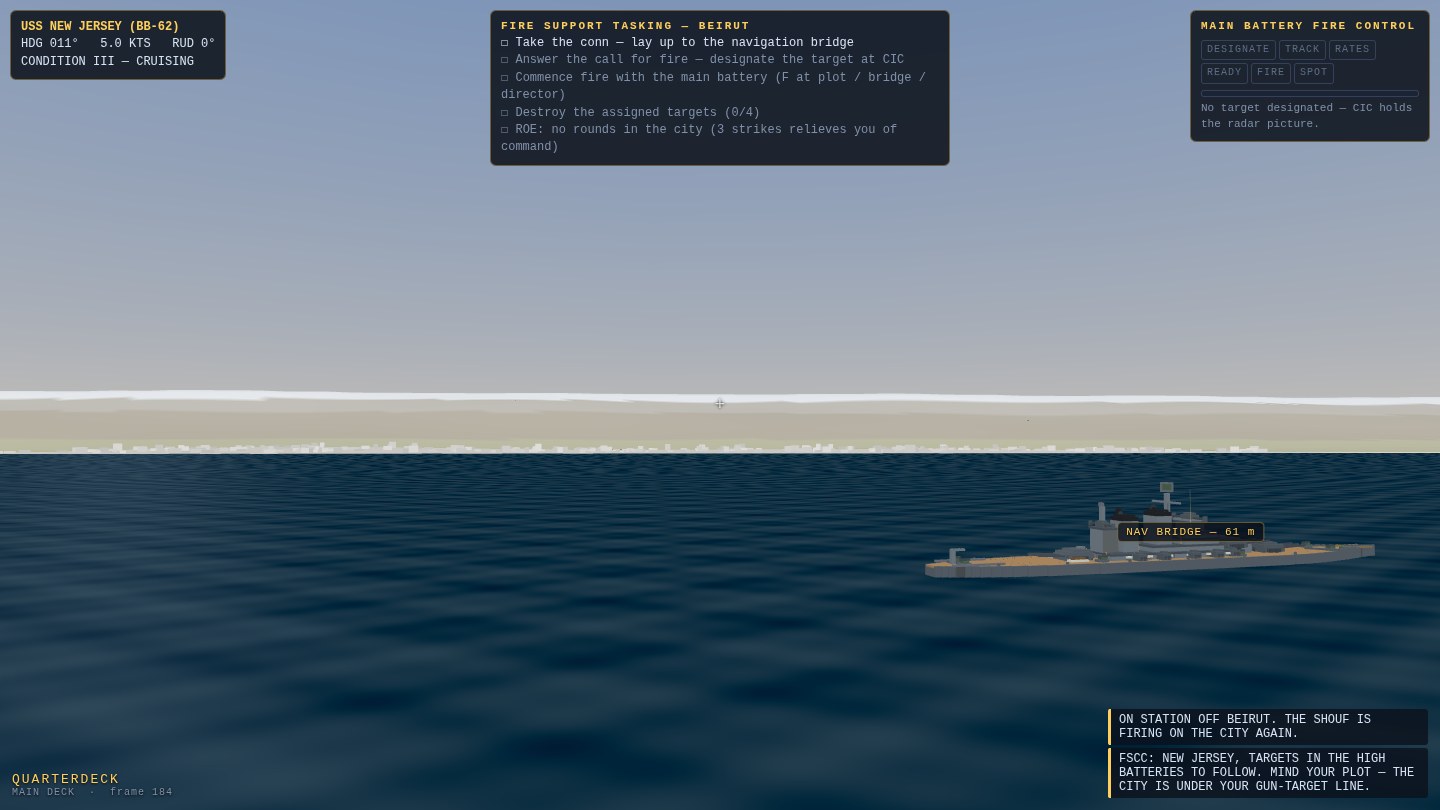
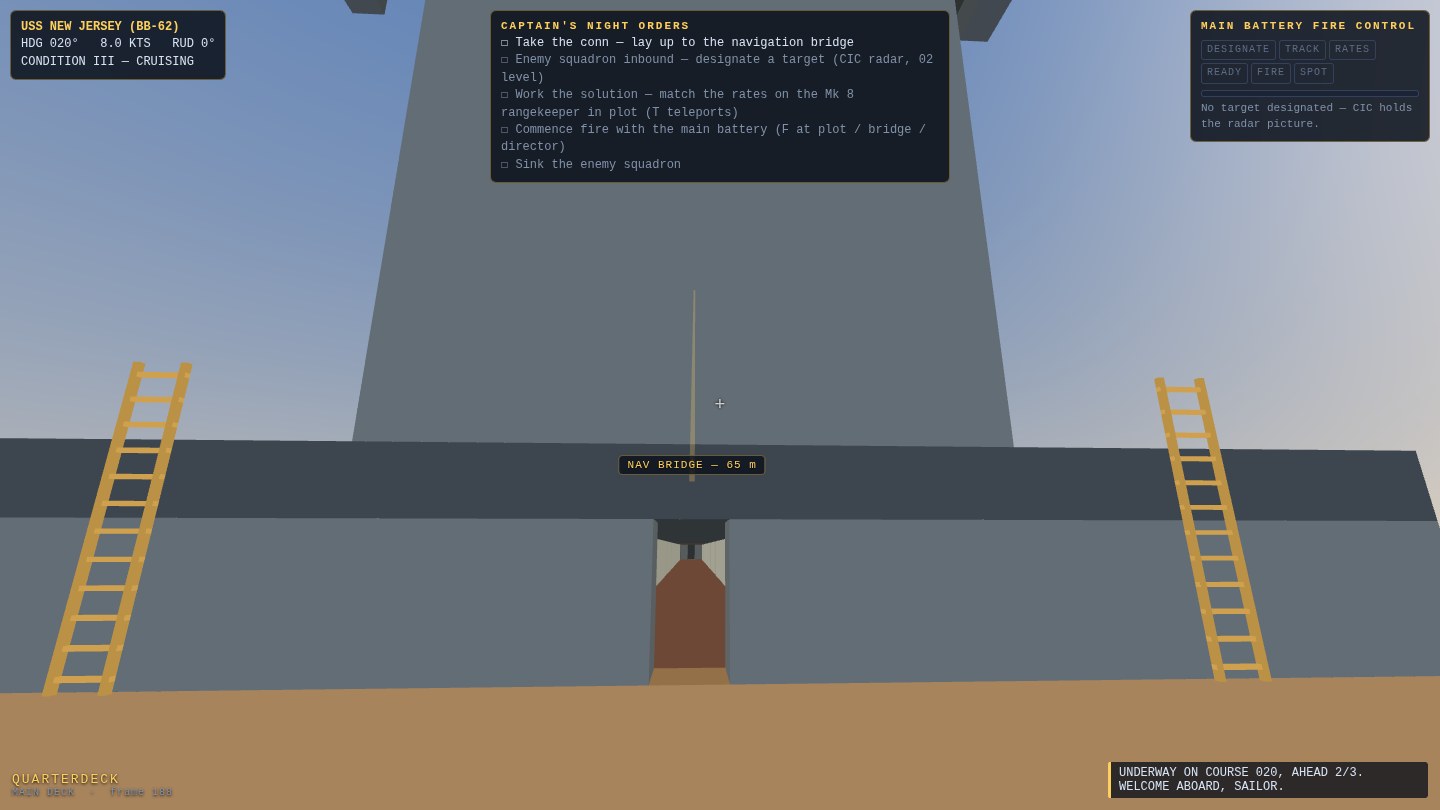
Walking the missions turned up a nest of embarrassments. Your very first order is “lay up to the navigation bridge,” and the ladder nearest your spawn climbed straight into a blank wall — the only route that actually worked was a long maze around the far side of the superstructure. Worse, most of the ship's ladders were climbable but invisible: you could ride them if you knew where they were, but you couldn't see a single rung. Getting anywhere on the Big J was a guessing game.
All fixed. Ladders are now real brass rails and rungs you can see and grab, they land where a sailor can actually step off, and climbing eases you gently onto the ladder so you thread deck hatches cleanly; tap SHIFT beside a hatch to take one down. Every order now throws a gold beacon up through the steel with a name and a range on it, on your HUD and on the deck plans, so you always know where you're headed. And for the impatient: press T and all seven of the ship's stations are one keypress away — jump straight to the helm, CIC, the plot, the director, and you're manning it. Walking her decks is the point; being lost on them isn't.
Same ship, same walk, three wars. Report aboard: warbirds.io/battleship.