Big J learns rate control
Until now the Big J's fire control did the interesting part for you. You designated a target and a quality bar climbed on its own until the guns released. The real ships didn't work that way — and the real method is a better game. This update turns the plot into rate control, a job you actually do: crank in the enemy's course and speed until your solution locks. It also lets you jump anywhere on the ship, ride your own salvo out on a chase cam, call your own spots from the director, and steams her back to a war this page had been skipping: Wonsan, 1951.
Only one combination is the solution
The Mk 8 rangekeeper was an analog computer that generated the target's motion: from own ship's course and speed (measured by gyrocompass and pitometer log, and therefore trusted) plus an estimated target course and speed, it dead-reckoned present range and bearing continuously. The operator's whole job — the doctrine called it rate control — was to compare that generated track against what the director and radar actually observed, and crank the target estimate until the two agreed. The manuals are lovely and blunt about it: only one combination of target course and speed will cause both range and bearing rates to agree, and that combination is the solution.
So that's the game now. Designate a target and the spotter passes plot a rough guess — "target angle three-three-zero, speed twenty" — deliberately off. Man the Mk 8 rangekeeper on the third deck and you get the machine's actual working surfaces: a time-range plotter where radar ranges arrive as phosphor dots and your generated range draws as a continuous pen line, and two needle-matching meters — range rate and bearing drift — each with a green observed bug and a gold generated bug. A/D cranks estimated target course, W/S cranks speed. Wrong estimate: the pen line pulls away from the dots and the gold bugs sit off the green. Right estimate: everything lines up, the SOLUTION lamp comes on, and the battery releases.
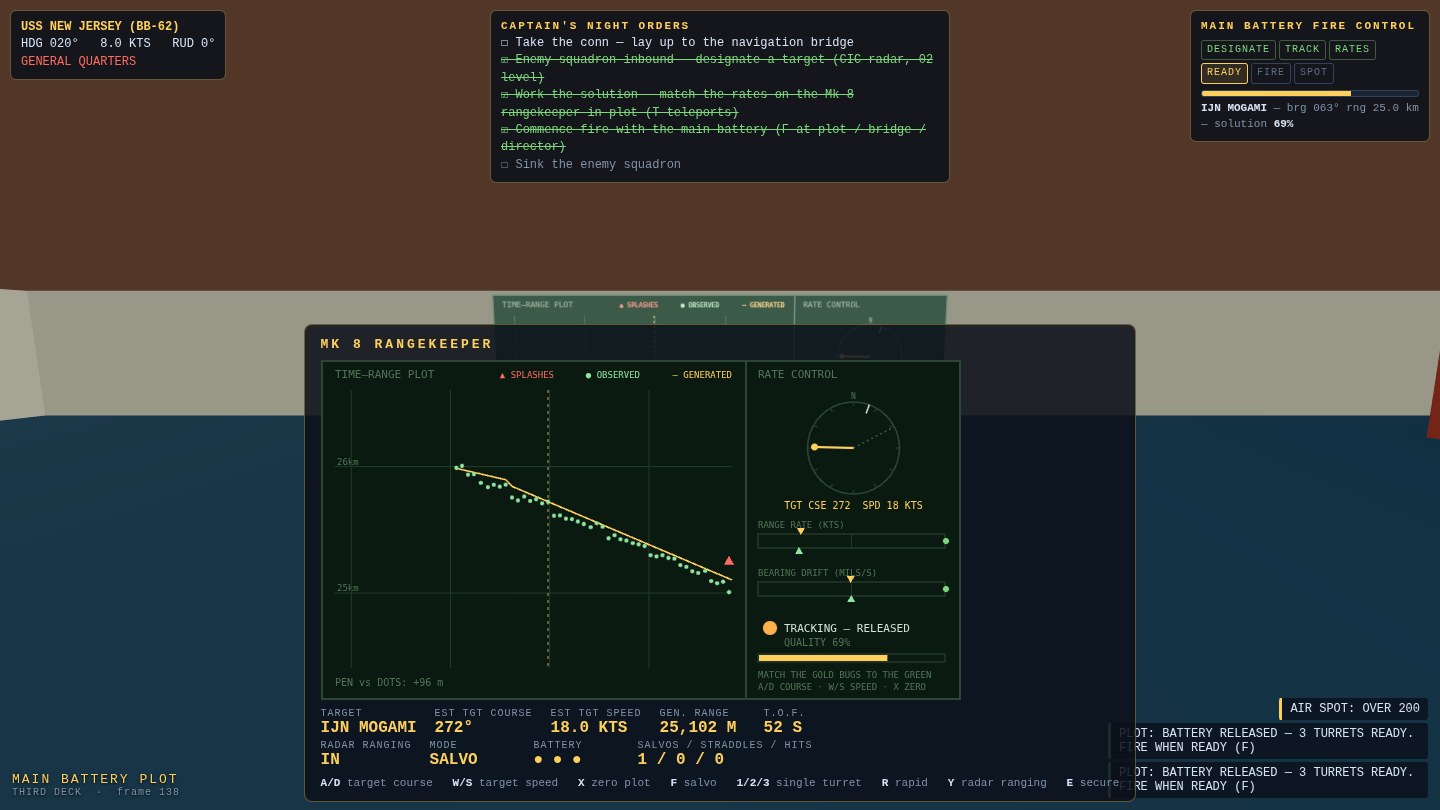
Wrong rates now miss
The old quality bar was cosmetic. Now your solution has teeth: salvos are aimed with the lead you cranked in, not the truth. Get the enemy's speed wrong by 15 knots and the pattern lands a few hundred meters off — you'll see the splashes miss and you'll know why. When the target turns, your rates go stale and the plot tells you so; knock out the radar and the dots stop arriving, throwing you back on optical cuts from the director like a night action. The fire-control team still works the knobs when you're needed elsewhere — slower, and never quite exact — so the ship fights without you, just better with you.
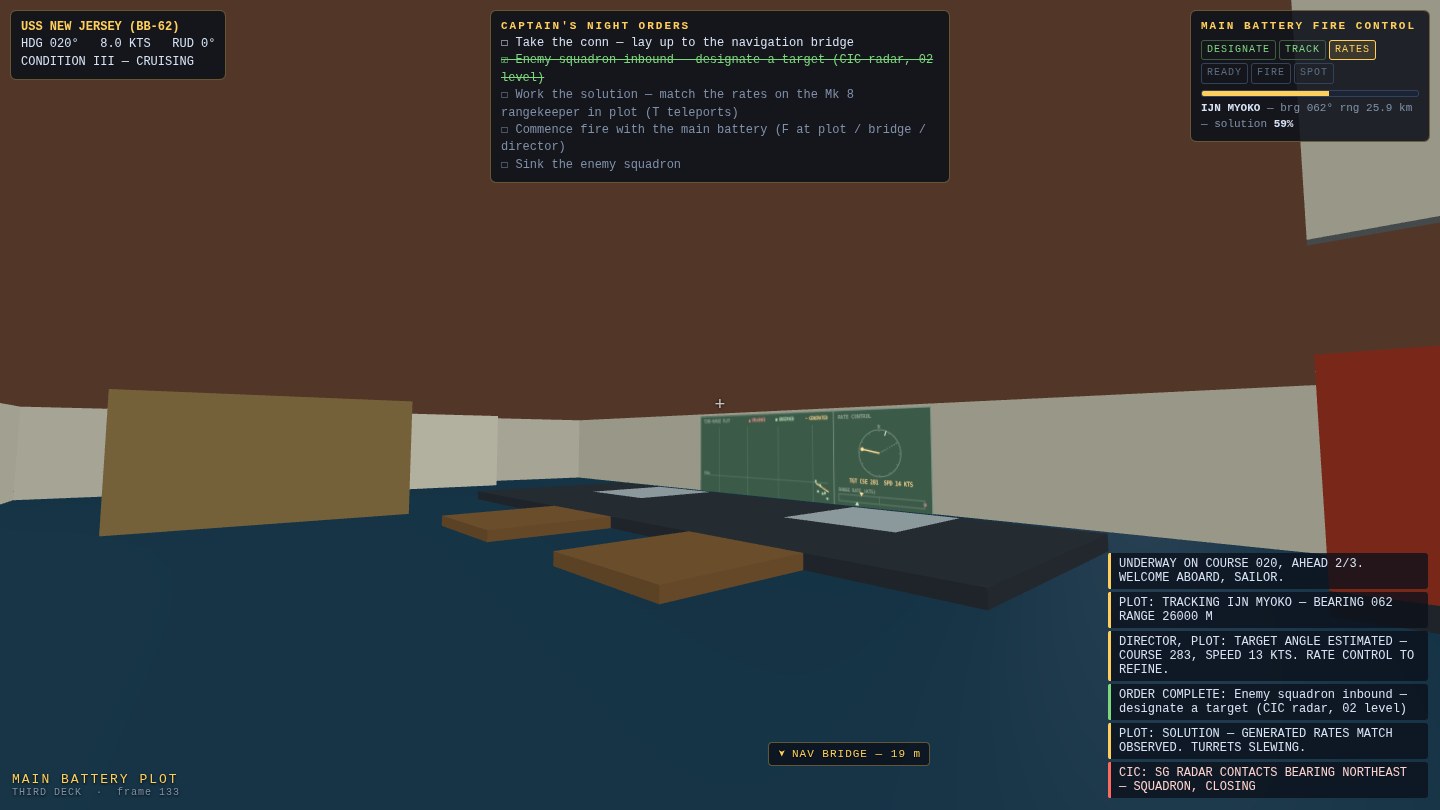
Nobody gets lost on their own ship
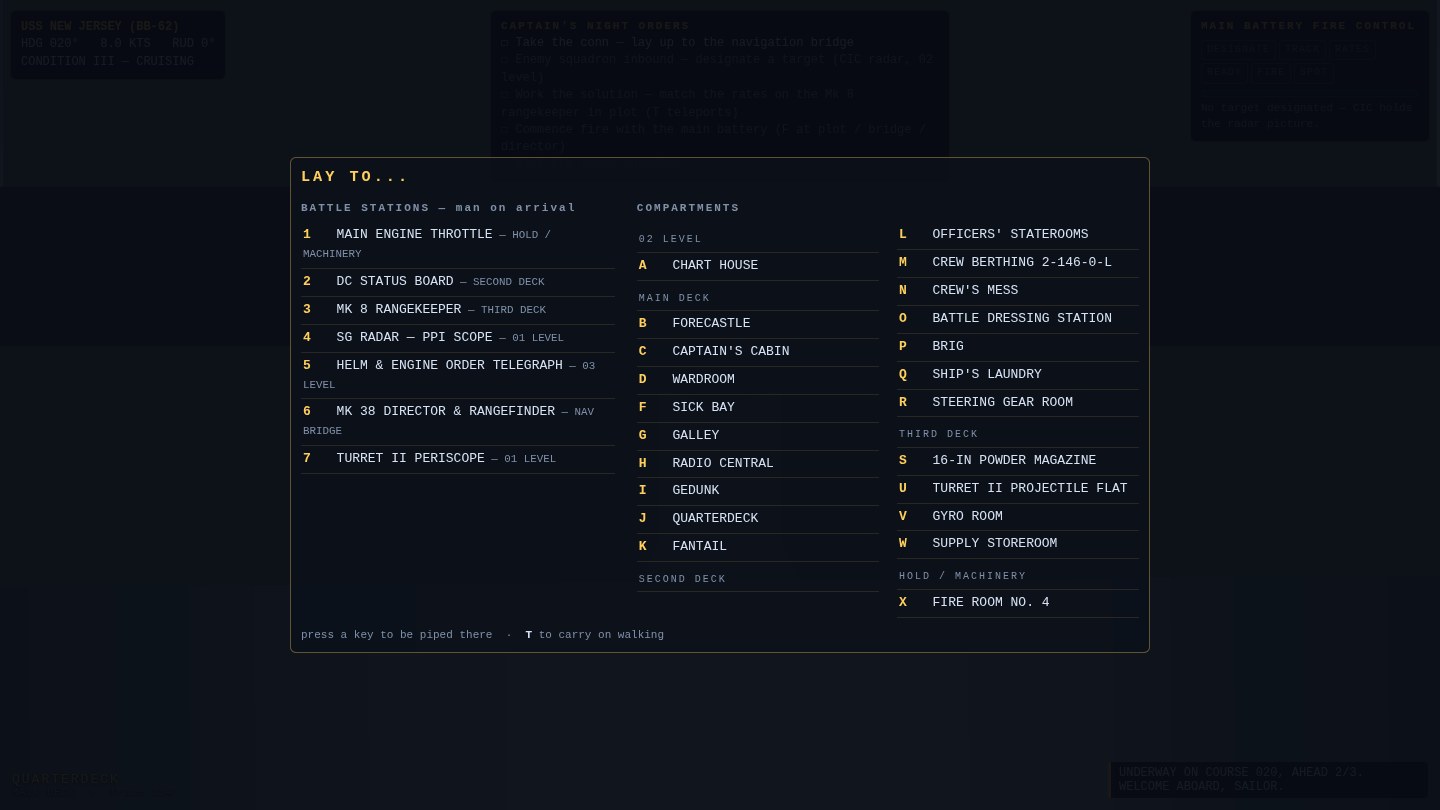
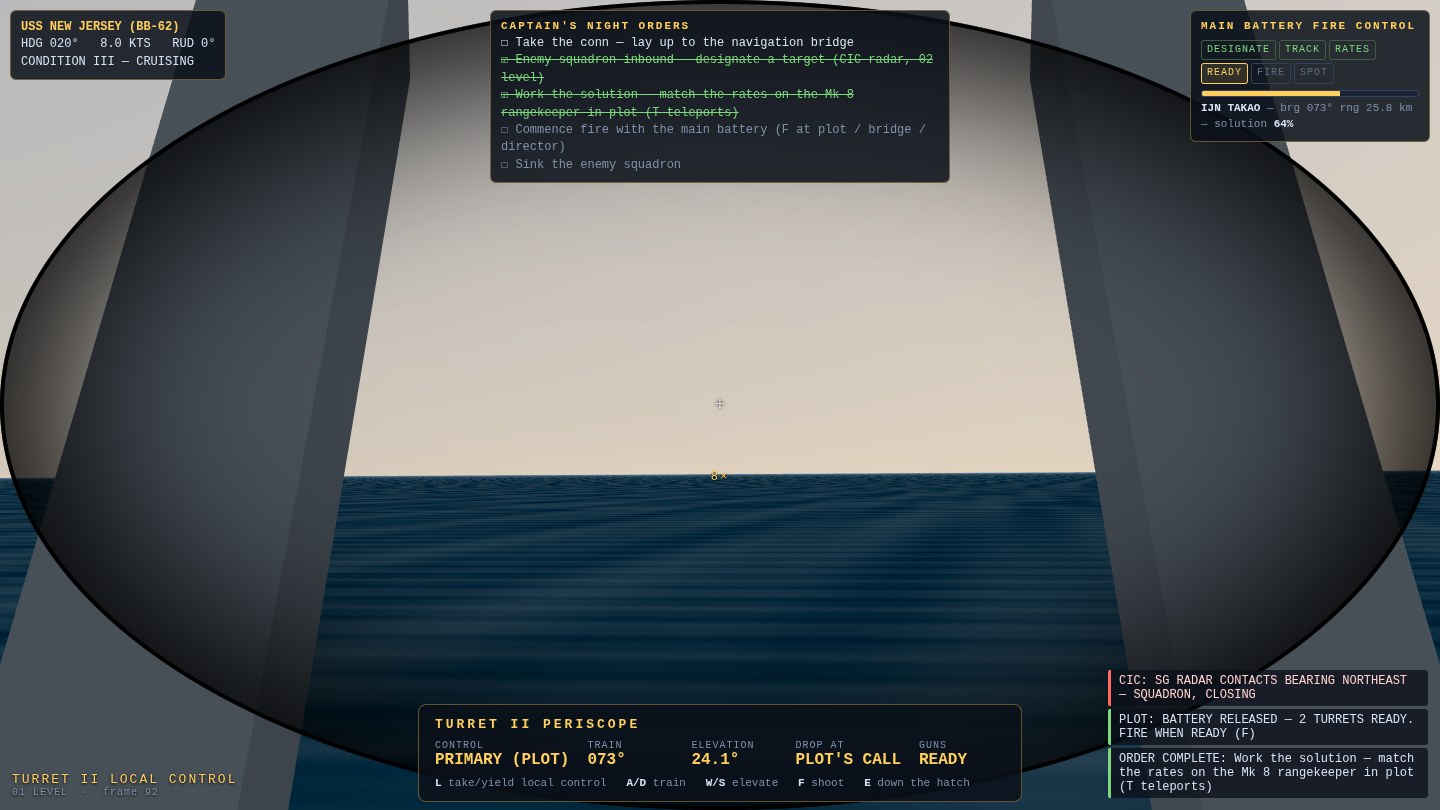
Walking a 270-meter ship is glorious twice and a commute after that, and main battery plot down on the third deck was a spelunking expedition. So T now opens the whole ship — seven battle stations by number, and every compartment by letter, grouped by deck, from the chart house down to Fire Room No. 4. The turret periscope now rides the gunhouse roof between the barrels and sees open sea, instead of staring at the turret's own rear plate, and the plot desk looks across the rangekeeper table at its glowing board.
Ride the salvo out
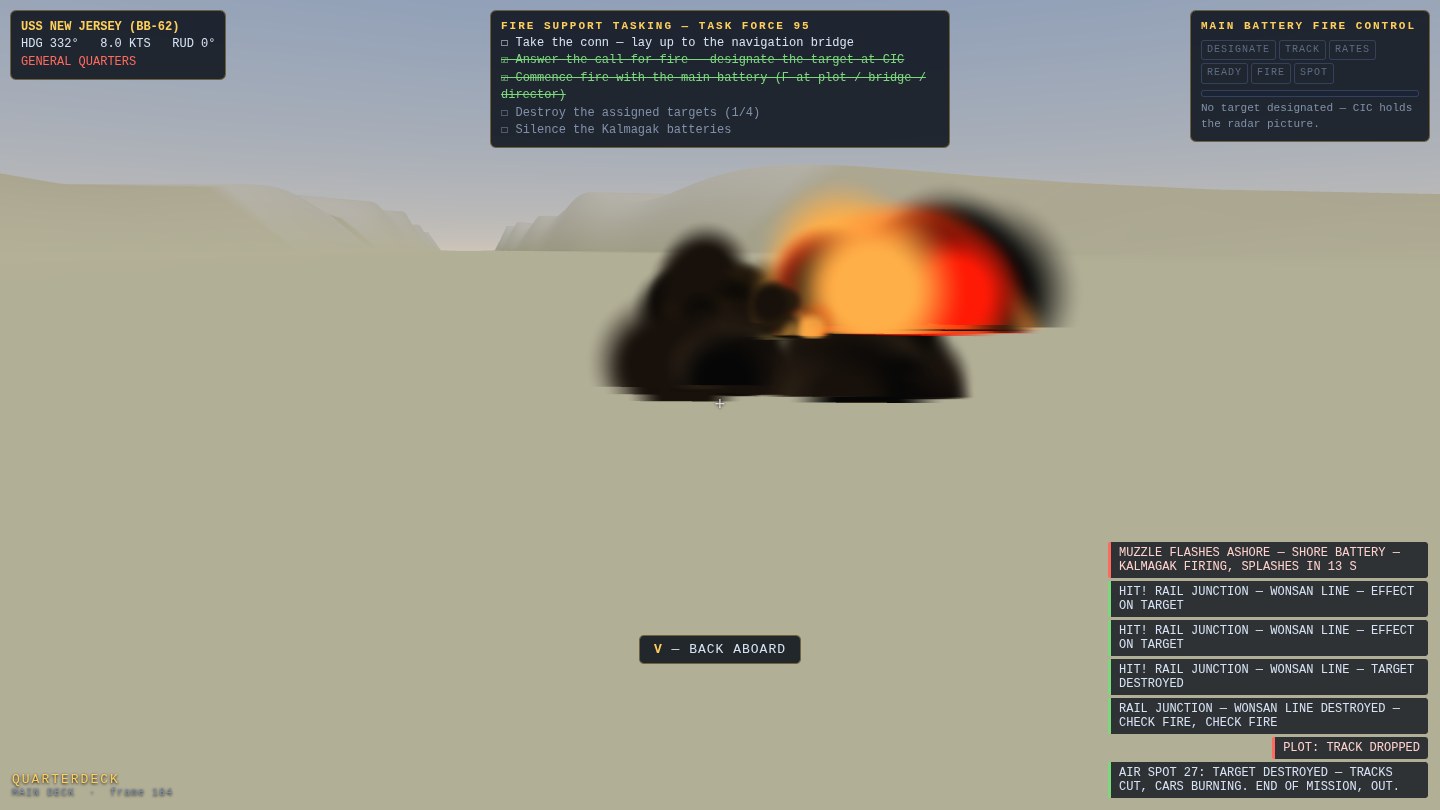
Nine guns fire and everything interesting happens eleven miles away. Not anymore: press V and the camera rides the last round out — a chase position off the shell's own tail, time compressing through the long cruise so the arc doesn't drag, then real time again for the plunge and the burst. It ends on the explosion, lingers long enough to watch the smoke climb, and puts you back aboard where you left yourself.
The spot is your call
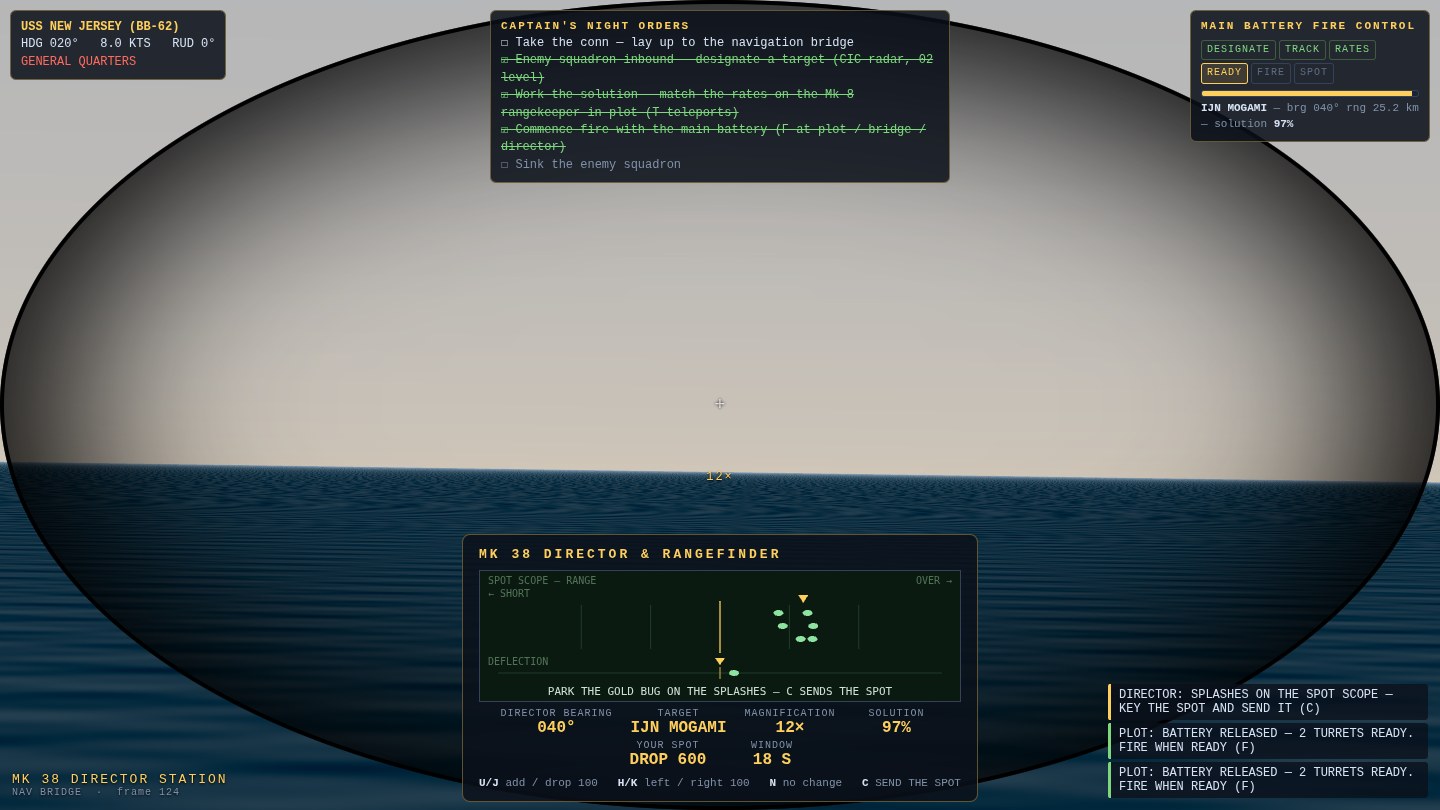
Corrections used to apply themselves. Now, if you're in the director when the salvo lands, the splashes come up as pips on the Mk 8 spot scope — the radar picture the real operators said was like "drawing the splashes on paper" — and the correction is yours to key: U/J add or drop in hundreds, H/K left or right, deflection then range in the traditional order, C to send it to plot. Park the gold bug on the splash group and a good call cancels the miss almost entirely; dither past the window and the weaker air-spot correction goes in without you. With the radar out, the pips scatter and spotting gets honest-hard, like a night action should be. And the plot now freezes its own rate corrections while a salvo is in the air — applying spots and rate corrections simultaneously is the "pyramiding" the gunnery manuals warn about, and it double-corrects the same error.
Wonsan, 1951
The mission select also grows a fourth card, and it belongs between 1944 and Vietnam: the Siege of Wonsan, the longest naval siege of the century, where the recommissioned New Jersey fired her first rounds in anger since 1945. Rail lines and gun caves above the harbor, a supply point on Hodo Pando — and the Kalmagak batteries, which had been registering on the anchorage for weeks. They unmask the moment your first salvo commits you, shooting like they know the range, because historically they did: on 21 May 1951 they hit her, the only combat casualties the ship ever took. If their gunners get lucky here too, the damage-control game you've been ignoring stops being optional.
And the ship got furniture
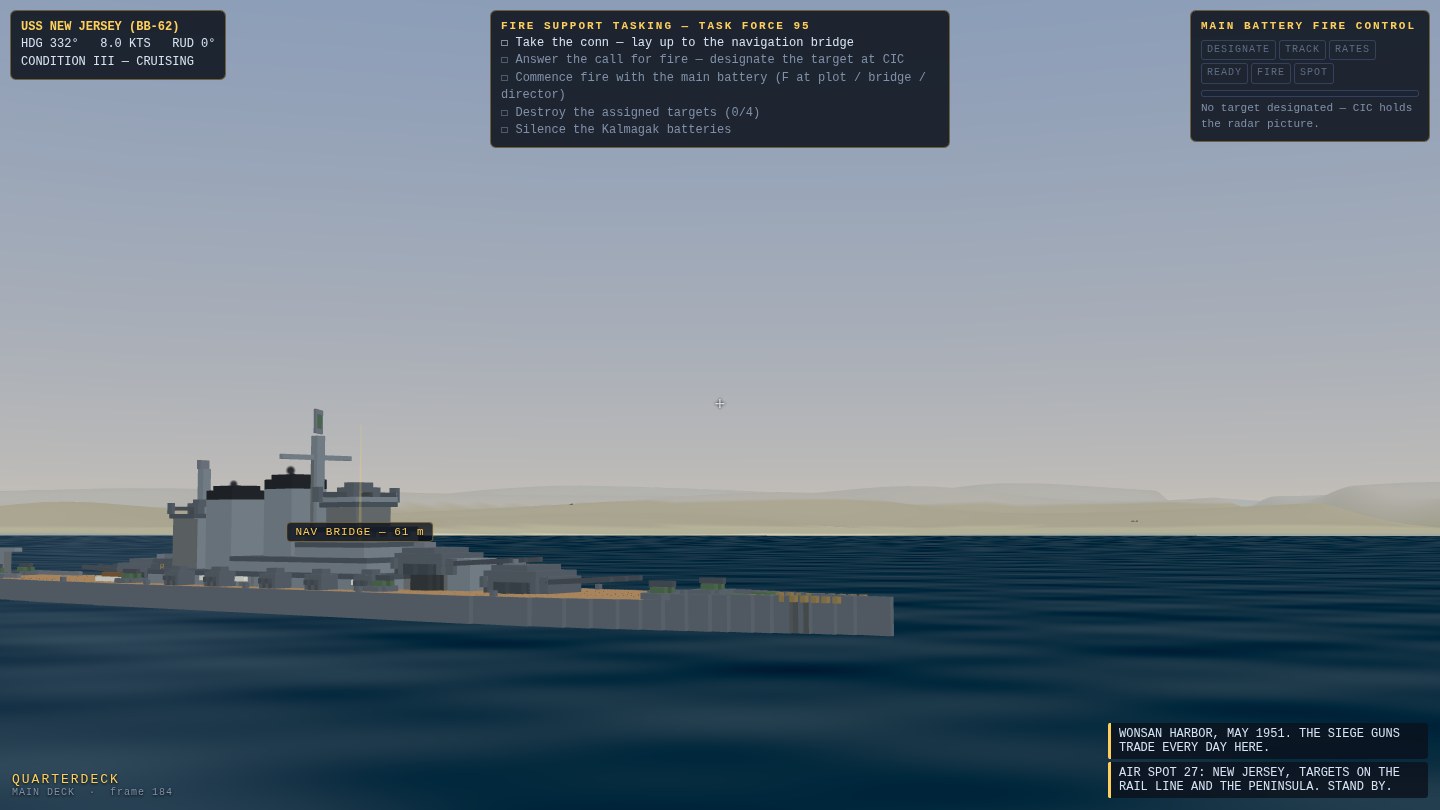
Every compartment picked up the fittings that make a space read as itself at a glance: gauge boards and firebox doors glowing in the fire room, a brass trick wheel back aft in steering gear, the wardroom's sideboard and coffee urn, red vinyl stools at the gedunk, stacked lockers in the berthing compartment, a red cross inlaid on sick bay's bulkhead, cable trays and battle phones where cable trays and battle phones go — every one of the thirty-odd compartments now reads as itself at a glance. The salvo buzzer rings twice in the turrets before the guns go, because of course it does.
Same ship, real fire control. Report aboard: warbirds.io/battleship — and if the pen won't sit on the dots, remember the trainer's rule of thumb: along the line of sight, speed moves range rate; across it, course does. Long hours of practice in tracking actual targets alone will provide the experience required.