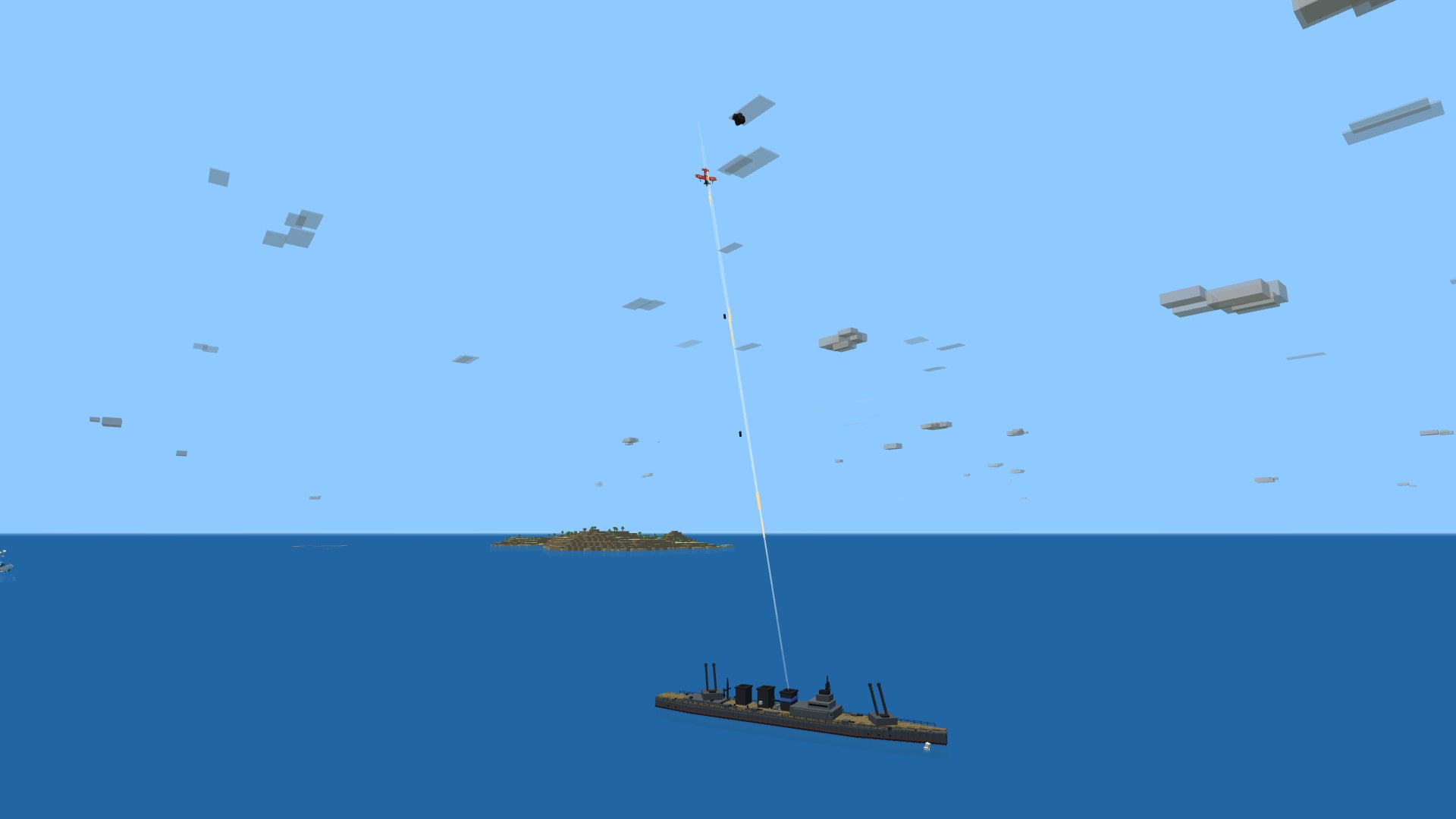
Down her stacks: the dive bombers
The naval strike wing learns the other classic carrier attack. Alongside the wavetop torpedo bombers, each side now flies dive bombers: ride in high over a warship, chop the throttle, coast just past her stern, wing over onto your back, pull the deck up into the sights, and let the bombs go down the dive. Teaching a six-degree-of-freedom flight model to do that took eleven broken attempts, and every one of them taught us something about why the real pilots trained for years.
The brief
The requested doctrine reads like a war movie: fly over a ship, zero throttle, cruise just past it until speed gets low, wing over to inverted, pull up to get the ship in the sights, release, pull out, slam the throttle back up and escape. The torpedo wing's brain is pursuit steering with a low altitude target — it could never fly this. A wingover-into-a-dive is a scripted aerobatic sequence, so the new brain is a phase machine: approach → run-in → overfly → wingover → pull-through → dive → egress, each phase with its own control law and a patience deadline so a botched manoeuvre recovers instead of tumbling forever.
What the flight model refused to do
We flew the sequence in a headless harness — the real brain, the real aerodynamics, a destroyer parked in open water — and logged every phase transition. The first drafts are a catalogue of honest aerodynamic failure:
The full-speed overflight. This airframe is clean: shedding the ~40 m/s between cruise and a sane push-over speed takes two and a half kilometres of idle coasting, and up at the perch the thin air makes it worse. The first wingovers happened at 120+ m/s, needed a kilometre of sky that wasn't there, and dove at empty sea. The zoom that flew beautifully and worked terribly. We tried bleeding speed by hauling the nose up first — it ballooned 400 m, stalled to 20 m/s, and everything after was a falling leaf. Worse, it turns out the pull-through's radius is lift-limited and barely cares about airspeed, so the zoom bought nothing and drifted the push point 600 m downrange. The eternal barrel roll. A bare full-deflection aileron input never brakes: it blew through inverted and re-armed itself on the far side, every pass, until a proper bank controller targeted upside-down the short way and stopped there. The slicing pull. Back-stick at 110° of bank rotates the nose earthward at a third of the rate — the wings have to be flat on their back before the elevator earns its keep.
And the one that shaped the whole geometry: the ship can only enter the windscreen after the nose sweeps past the vertical and the heading reverses. An exit condition of “steep enough” hands the dive a heading that never reversed. The pull ends when the deck is actually in the sights — which is, of course, exactly what the brief said in the first place.
Flying the pipper, not the nose
A dive whose nose sits on the hull always drops short: the bomb leaves with the plane's velocity and carries downrange. So the dive phase integrates the bomb's real ballistics every tick — the same gravity and drag the live bomb flies — and steers at the mirror of the miss, aiming long while the impact point trails the ship and easing off as it walks up the deck. Release comes when the ballistic point crosses the hull; at the 170 m floor a near-solution gets the parting shot and the throttle gets firewalled either way. In the harness the walk converges from a 1,300 m miss to under 30 m in about five seconds of dive, and both bombs come off inside the blast radius of a stationary destroyer.
The live-fire humiliation
Then we put the wing into a real battle and it dropped zero bombs in ten minutes while losing 24 aircraft. The kill log said flak, twenty-three times. The bombers were spending 97% of their lives in the approach — clawing back up to the perch inside the ships' 2 km Bofors envelope after every dive, and dying there. Three fixes, all of them things a 1942 air group knew: the wing now stages at altitude, reforms and climbs outside flak range before turning back in, and flies its final from an initial point — because the bearing autopilot's turning circle is wider than its own detection range, and only a long straight run-in ever actually crosses the deck. One fix was ours alone: the naval theater had never fielded a bomb-carrying plane, so nothing ever stepped bombs after release — they froze in mid-air, forever. The probe caught a bomber's whole stick hanging over the sea like a decoration.
After the fixes, the same ten-minute probe: 8 bombs dropped, 5 bursting within 50 m of a hull, 2 warships sunk, and losses down from 24 to about 7. Which brought up the opposite problem.
Taking the sniper rifle away
Two sinks in ten minutes from four bombers, stacked on top of a torpedo wing that already hurts ships badly, is too much killing power from the sky. So the finished doctrine deliberately isn't a sniper rifle: every attack rolls an aim error at the push-over — the pipper walks faithfully onto a point that is usually a ship-length or two into the water beside her. In the 20-minute probe the sticks now burst 31–66 m off the hull: proper close-aboard straddles that sting through the splash, with the clean deck hit a jackpot rather than the expectation, and zero sinks. The dive also can't be re-tasked once committed — the bomber presses through the flak screen, pulls out at 170 m, and runs out flat on the water before climbing away to reform. The flak splits its attention; the torpedoes keep the ship-killing job; the full-match balance probe holds hull lifetimes steady.
The air game is untouched — the doctrine dispatches off the naval seam and nowhere else, and the golden-bytes guard agrees. Next: letting a player fly the dive themselves, with the wing as squadmates.