Four guns talking
Since the first prototype, every plane in Warbirds has fired the same armament: one gun on each wing, volleying together. This pass sorts the roster by bore instead. The .50-cal fighters — Sparrowhawk and Swordfin — now mount a quad battery, two barrels about a foot apart on each wing, and all four fire every volley: double the rounds in the air, a genuine hose. The 20 mm Thunderhead keeps the classic pair. And the heavies go the other way entirely: the Ironclad's 30 mm becomes a single chin cannon on the centerline and the Starfang's armament is one six-barrel gatling in the port cheek of its nose. It took three drafts to get the balance right, and the first two each taught us something.
The bookkeeping under the barrels
Guns here are an abstraction with a strict budget. Each caliber owns
a roundsPerSec and a damage, and a plane's
damage-per-second — the number the AI's threat tables, the
balance probes, and three theaters of tuning all lean on — is
their product times the barrels spending it. Mount more guns and
something has to pay. The knob we settled on is the honest one:
the round itself. The quad fifties fire a new quad-rated
.50 caliber at half the damage per round — twice the
rounds, half the round, the ledger doesn't move. The Leviathan's
chin pair, the bomber turrets, and the scout car's pintle .50 keep
the original caliber untouched. The singles pay nothing because they
take nothing: one barrel streaming at the caliber's full per-round
rate delivers exactly the rounds-per-second the old pair did —
the Ironclad's 30 mm thumps 4.5 heavy shells a second from a
chin fairing under the bombardier's glass, and the Starfang's Vulcan pours thirty
20 mm rounds a second out of one muzzle, a buzz instead of a
drumbeat.
Two drafts died so this one could fly
The first cut kept the caliber table untouched and slowed the volley clock instead: all four barrels fired together at a quarter of the per-round rate, sustained DPS identical. The air difficulty probe — three seeds, five bot variants, 300 simulated seconds per cell — came back with bot-vs-bot gunfire kills down about a fifth: 0.97 to 0.79 per minute. Sustained DPS was preserved; windowed DPS wasn't. A firing solution in a turning fight lasts half a second, and a 30 mm quad volleying every 0.9 seconds kept missing its cue. An existing test caught the matching cosmetic failure: per-volley tracers on a quarter-rate clock put the streak interval past the bullet's own lifetime — a gun stream with holes in it.
The second draft fixed the numbers with a trick: volleys alternated between the inner and outer pair, keeping cadence, throughput and damage byte-identical to the old pair. The probe loved it. The design review didn't — four guns that fire two at a time are a pair with extra fittings. If the wings carry four guns, four guns should talk, and the volume of fire should be the thing you feel. Hence the final form: all barrels, every volley, at the classic cadence — and the round weight, not the clock, pays the bill. Re-probed, bot gunfire kills and human survival landed back inside seed noise of the live game.
The doctrine, plane by plane
The review left the roster with a rule a player can feel through the trigger: the smaller the bore, the more barrels. Machine-gun fighters hose — 48 rounds and roughly ten tracers a second off a Sparrowhawk's wings, four streams converging on the harmonization point, each plink lighter but the sky visibly thick with lead. Cannon fighters volley — the Thunderhead's paired hispanos are untouched, still the boom-and-zoom scalpel. And the heavies deal one card at a time: the Ironclad's cannons left the chin pair and the wing pods of the drafts behind and settled as a single big centerline gun slung under the bombardier's glass (a twin has no central spinner to fire through) — and the Starfang finally matches its own panel lines — the model always showed one gatling port on the nose and never a wing gun. In a browser playtest the jet keeps roughly four times as many rounds in the air as the old wing pair delivered in tracers — same damage budget, delivered as a stream.
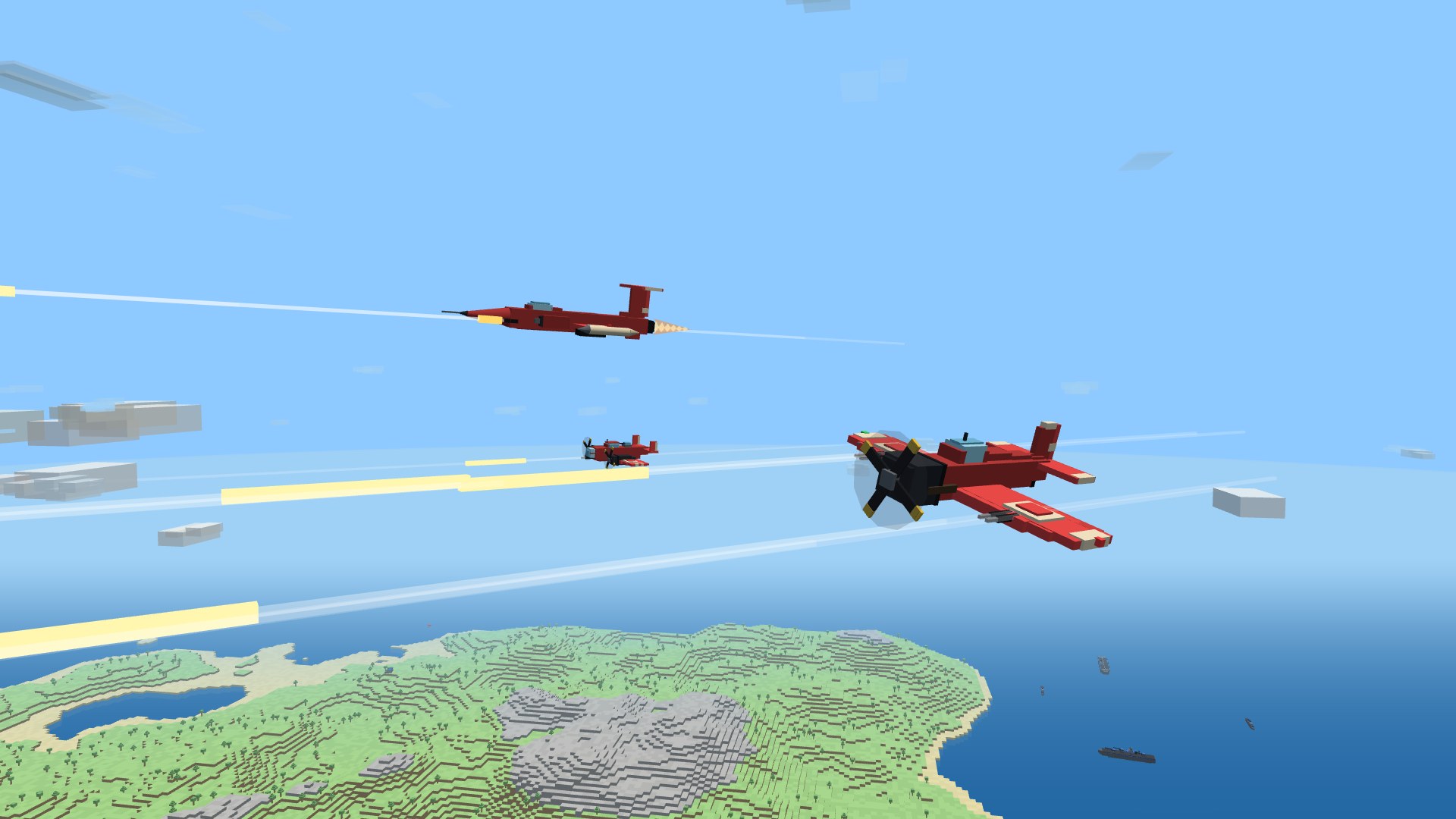
One honest confession from the process: the screenshot rig that took
the picture up top had the old armament baked into it — its
gunsFiring helper streamed tracers from muzzle
[0] and muzzle [1], hardcoded, forever the
pair. Left alone it would have photographed the quad as two guns and
indexed straight past the end of the Starfang's one. The camera crew
believed in the wing pair as firmly as the flight code did; both had
to be told.