The empty steppe
The land war had one nagging complaint: “something is off — maybe too many hills, too high? I can never find enemies.” It was right. You could roll off spawn, drive for what felt like forever, and never lay eyes on a Cobalt hull. This is the pass that put a fight back on the Brick Steppe.
The steppe that swallowed the war
The old steppe was enormous and lumpy in exactly the wrong way. It was a long drive from spawn to anywhere, and once you got there, endless waves of hills, folds, and thick forest chopped the horizon into short blind pockets. Your gun could reach across kilometres, but the ground almost never let you see that far — enemies flickered into view for a heartbeat between folds and vanished before you could traverse onto them. Whole rounds went by where the two sides barely met. The war wasn’t just quiet; the map physically wouldn’t let it happen.
A steppe you can fight across
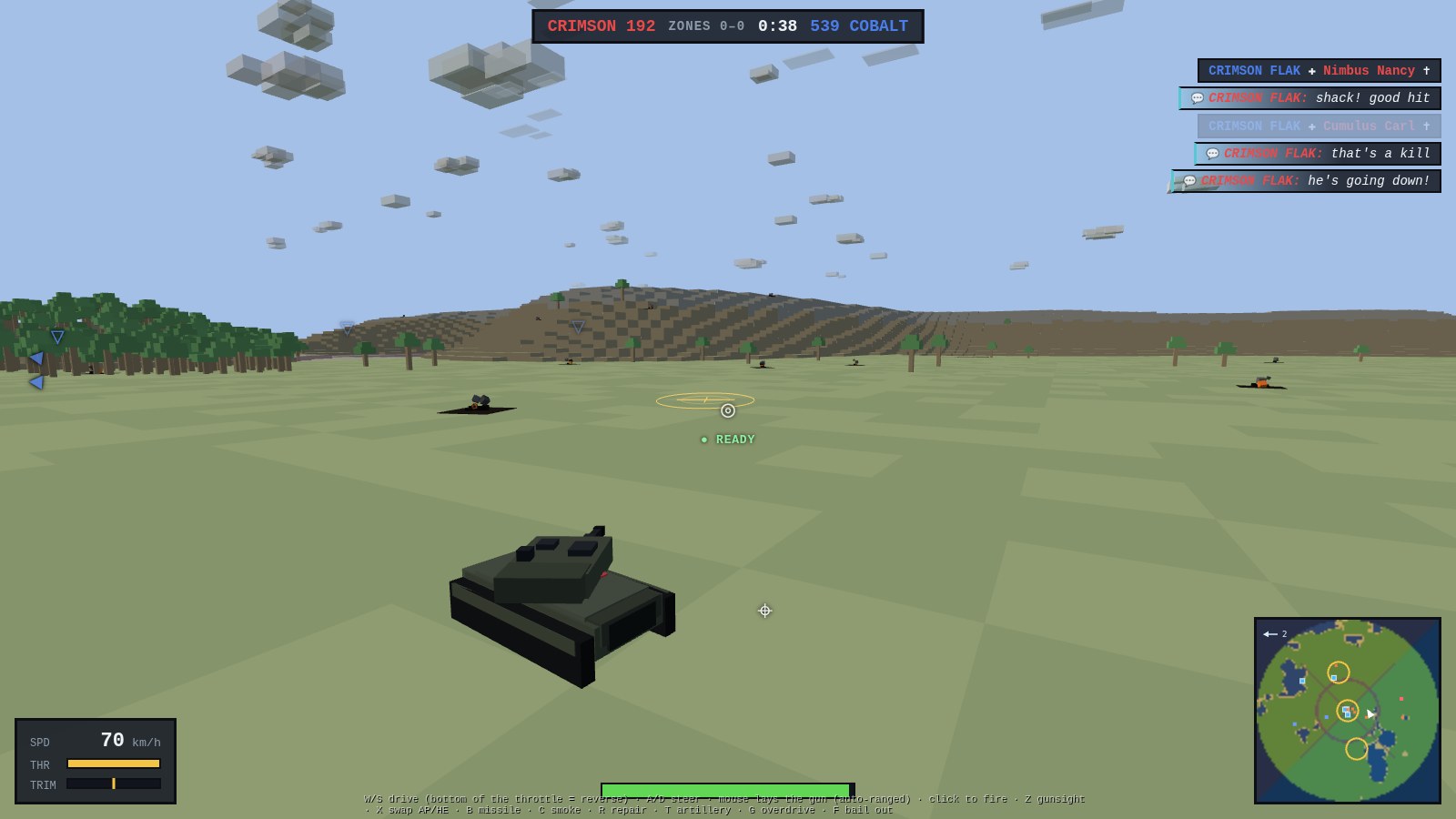
The battlefield is tighter and more open now. It’s smaller — the drive to contact drops to well under a minute while gun duels still play out at proper range. The hills are fewer and lower, so they frame the fight instead of walling it off. The folds you fight from are still there — hull-down ridges and dips to peek over — but they no longer mask every lane. And the forest is thinned to about half of what it was: treelines now read as cover and ambush spots, not a labyrinth you get lost in. More hulls take the field on each side, too, and you spawn closer to the action.
The change you’ll feel most is spotting. A contact you’ve seen now stays marked for five seconds after it slips behind terrain. The steppe’s folds still break your line of sight every few hull-lengths — that’s the terrain doing its job — but a tank dipping through a hollow no longer blinks in and out of existence on your screen faster than you can swing the gun. The caret holds; you can commit to the shot.
An enemy that brings the fight
The AI used to sit on the centre of the map and let the round drift away. Now the enemy line marches on the nearest contested or lost zone — it comes to take back ground, which means the fights break out at the objectives you’re already driving toward. And when two heavies meet head-on, they no longer park nose-to-nose bouncing rounds off each other’s thick front plate forever. Facing armour it can’t crack from the front, the AI now circles for the side plate — the exact flanking dance the armour model has been trying to teach you all along. Expect to be outmanoeuvred if you sit still.
The result is a steppe with a pulse: first blood inside the first minute or two, kills throughout the round, an enemy on the board somewhere almost the whole time, and matches that finish as real contests instead of shutouts.
No more silent stall
One last fix for a small, maddening thing: hold forward into a treeline and the game used to tell you nothing. The hull would sit at a dead 0 km/h, throttle pegged, engine roaring, going nowhere — and nothing on screen would say why. Now, a couple of seconds of ordered-forward-but-not-moving and the warning calls it out: HULL BLOCKED — BACK UP (S) AND STEER AROUND. Same treatment the ships already get when they run aground — the banner tells you the fix, not just the problem.