The town that fell silent
Land battles had a way of grinding to a halt. Tanks would roll into the same town, park nose to nose with the enemy… and just sit there. Guns silent, the score frozen for minutes at a stretch. Nobody was stuck on a treeline, nobody was out of ammo. The whole front had simply… stopped. Two things were choking the fight, and both are fixed now.
The gun that couldn’t look down
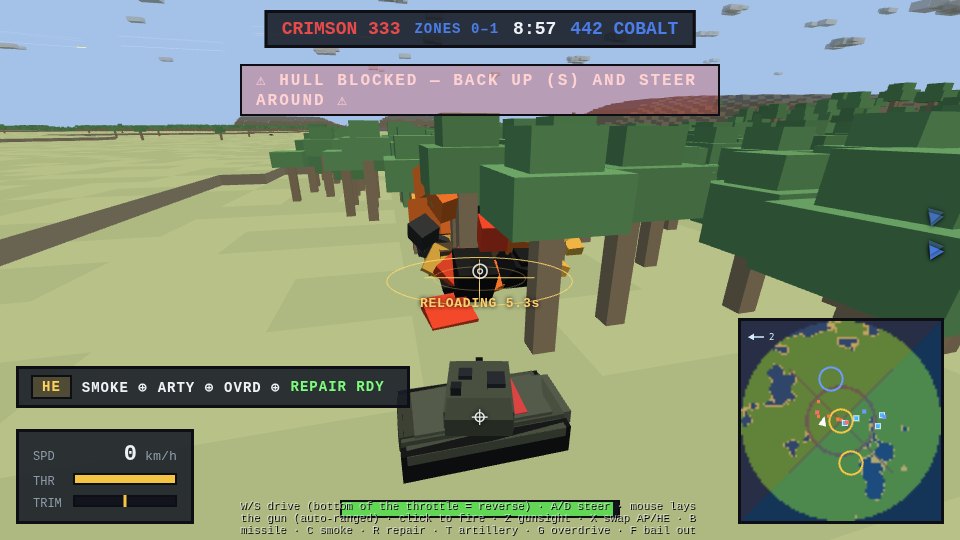
Tanks in Warbirds sit up high — they have to, or a low barrel would just stare into the lip of the next hill. But that height came with a catch: the gun couldn’t aim down far enough to hit anything close. Drive an enemy hull right up under your nose and your own barrel refused to touch it — a whole town block of dead zone where two tanks could sit a stone’s throw apart and neither could shoot. The bots hit the same wall: they’d line up a perfect point-blank shot and then wait, forever, for an angle the gun couldn’t give.
Now the gun aims properly down. The close-in blind spot shrinks to about two hull lengths — closer than armor ever really fights — and the crew takes the best shot the mount can give instead of holding fire for an impossible one. Park a tank a bow’s length away and you can finally put a shell through it.
Garrisons that stared at ghosts
With the guns talking again, a quieter deadlock turned up. Two gun trucks — one Crimson, one Cobalt — would roll into the same village, park on opposite sides of a rise, and hold. Each knew the other was there. Neither could actually see the other over the hill. Their orders said hold the flag, so they held it — contested, scoreless, for eight straight minutes. Two parked trucks staring at the same hill was the whole war.
Now a garrison holding a zone against an enemy it can’t quite see drives toward the contact — a committed, straight-in advance, no dithering (armor advances, retreats, or holds; it does not dance) — and the moment it crests the rise and lays eyes on the target, it opens up. Zones flip again. Rounds end again.
How it plays now
The front moves. The score climbs every minute instead of flatlining; zones change hands, one side caps out and the map redeploys for the next round. And the fights themselves changed shape: instead of two lines of tanks parked and plinking armor they can’t beat, hulls maneuver, work around each other, and punch through the thin side and rear plate. Movement makes flanks, and flanks make kills. From the driver’s seat it’s the difference between watching the enemy sit and dying gloriously at three hundred metres, mid-maneuver, to a crew that a week ago would have just watched you park.