Keep your distance: the fleets now form up and stand off
The ships used to drift wherever the coastline let them. Now each team deploys in a proper diamond and anchors a deliberate distance from the enemy — just out of gun range. To reach the other fleet you have to put a plane over it.
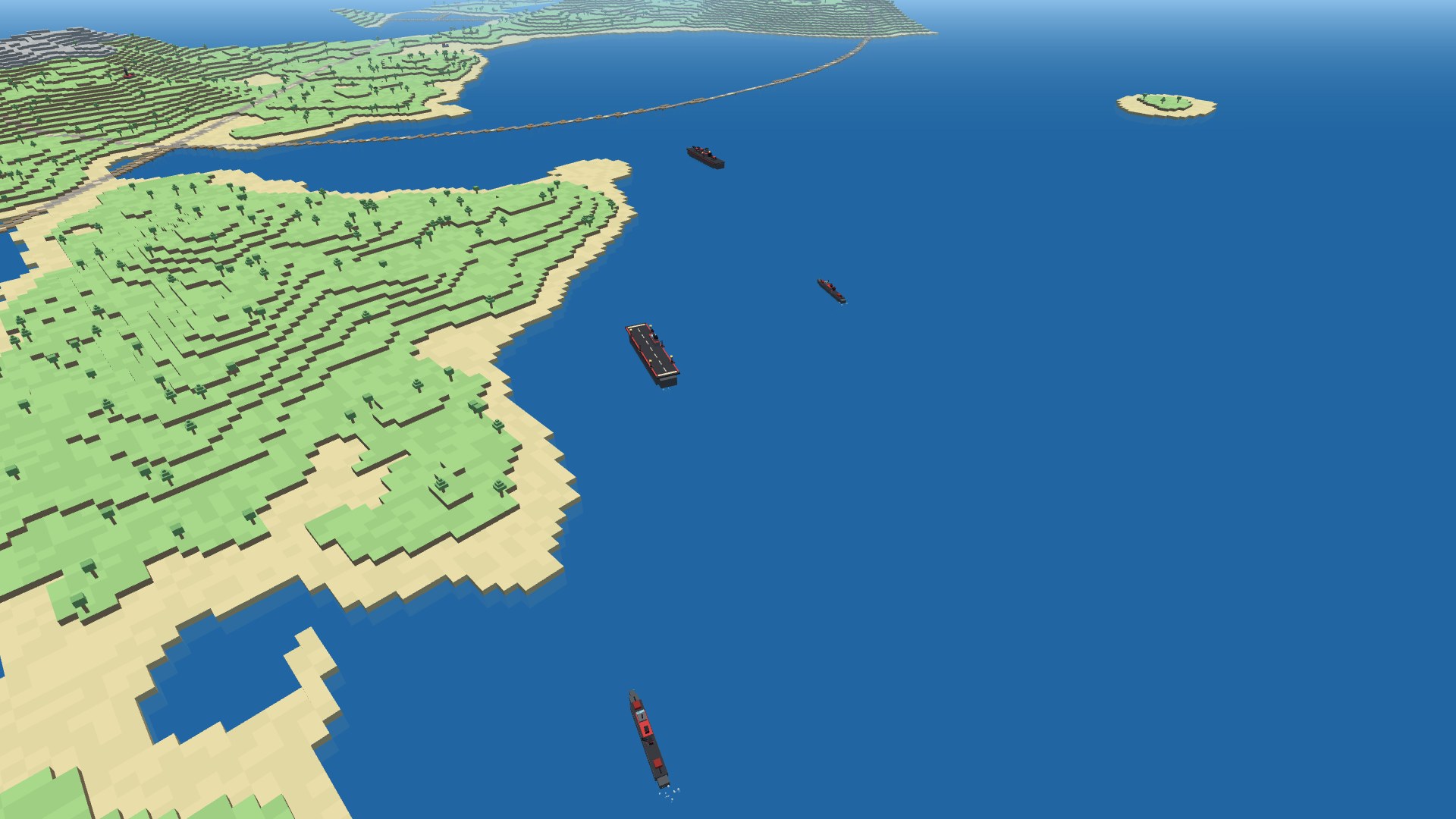
A fleet, not a scatter of boats
Each team has always fielded the same four hulls — a battleship, a carrier, and two destroyer escorts — but they were placed one at a time, each searching the coast for its own patch of open water. The result was a loose scatter that didn't read as a fleet so much as four ships that happened to be nearby.
Now they form up. The four hulls hold a diamond pointed straight at the enemy:
- the battleship takes the van, turned broadside on so its full length faces the fight;
- the two destroyers screen astern of it, out on either beam;
- the carrier brings up the rear, bow forward, so its catapult still launches you toward the action.
It's the same set of ships, but it finally looks like a task force steaming in company — and it gives the battle a front to it. The battleship is the hull closest to the enemy; the carrier you're trying to protect sits safely behind the screen.
Anchored just out of range — on purpose
Here's the part that changes how a fleet round plays. The two diamonds are set down a measured distance apart: past the range a battleship can shoot unobserved, but inside the range it can reach with a spotter. Neither fleet can simply open up on the other.
If you've crewed the big guns you know the two rings on the plotting chart: an inner direct-fire ring you can shell on your own, and a wider spotter ring where the battery won't loose a shell until a friendly plane is loitering over the target. We moved the fleets back so the enemy task force lands in that outer ring. The enemy battleship, its escorts, the carrier you actually want to sink — all of it is reachable, none of it without eyes overhead.
Two battleships can't just trade salvos across the water. To touch the enemy fleet, somebody has to fly over it.
That's the whole point. A fleet engagement stops being a slugging match decided by who clicked first and becomes a contest of spotting: one team threads a plane over the enemy diamond and walks shells onto it, the other scrambles to shoot the spotter down before the salvos find the carrier. The big guns still bombard the enemy coast on their own — the shore batteries sit inside direct-fire range as before — but the ships themselves are a problem you can only solve together.
Back off the beach, too
While we were at it, the whole formation got pulled off the shoreline and into open water. The old placement could tuck a hull right up against the rocks; the new one gives every ship room to sit in clear sea with its escorts around it. It looks better from the air, and it means a torpedo run on the carrier has to come in past the screen instead of sneaking down a strip of coast.
Why we did it
Warbirds keeps leaning into the same idea: a battle should reward a crew, not just a trigger finger. Crewable big guns gave us a gunner's seat; spotting gave the gunner a reason to want a teammate in the air. Standing the fleets off at spotter range makes that loop the center of a naval round instead of a bonus. Get eyes over the enemy diamond and the heaviest guns on the map are suddenly yours.