Hold the pip, hit the plane
You told us the guns were too inaccurate, and you were right. Lay the lead pip dead on a crossing fighter, squeeze, and the tracers sprayed around it — from a flak gun at a kilometre, most of the stream went nowhere near the plane you had aimed at perfectly, and a Leviathan's tail gunner threw most of his rounds past the fighter sitting in his six. At sea it was worse: a captain could lay the ring dead on a cruiser and watch the salvo come down anywhere across a kilometre of water, and on the Brick Steppe a Paladin's dart laid on a tank's nose at long range missed her nearly half the time. Every gun was being blamed for somebody else's misses. Not any more.
The gun shoots where you aim
Every flak gun in the war now throws its rounds the way a real gun does: in a cone a few mils wide, a handful of metres across at a kilometre. Put the lead pip on a plane and hold it there, and the stream goes to the pip. Hold it on a crossing fighter at six hundred metres and practically every round of a fleet Bofors clip goes where the pip was; before, about one round in twenty did.
That makes leading the whole skill. Read the crossing, lay the pip, keep it there through the burst. Miss now and it was you, not the barrel — and a hit is yours.
It is every flak gun you can crew or drive:
- the 88s on the shore flak line (the ☄ AAA tab) and the carriers' twin Bofors (the ⚓ NAVY tab);
- the Quad Flak half-track and the Scout Car's fifty on the highway convoys;
- and the Whirlwind, the sky-sweeper of the Brick Steppe, whose quad twenties now chew up a soft-skinned truck exactly where you point them, too.
The Warden's autocannon already shot true and is unchanged.
Your own guns, too
The same goes for the guns you fly. Every fighter's battery now puts its volley down one tight line: hold the pip on a bandit at five hundred metres and a Sparrowhawk's four fifties land every round on him, where before nearly half went wide. The Thunderhead's cannon, the Swordfin's fifties and the Ironclad's thirty all shoot just as true out to five hundred metres.
Harmonization still matters. Each battery is aimed to meet at its own range, a few hundred metres out, and guns spread far apart along a wing part company past it — stretch the Leviathan's nose guns much beyond four hundred metres and the pair starts to straddle a fighter instead of hitting it. That's the geometry of the wing, and the pip can't fix it; close in.
The biggest change is in the bomber. A Leviathan's tail and top gunners used to put barely a third of their rounds on a fighter four hundred metres astern, even with the pip dead on him. Now it's every round. Crew a turret from the ✪ BOMBER CREW tab, hold the pip on the fighter settling into your six, and he pays for it.
Your broadside lands where you lay it
The warships were last on the list, and they needed it most. The gold ring your gunsight paints on the water promised a salvo would come down within a couple of hundred metres of it, while the shells actually landed anywhere across a kilometre and more of sea, long and short. Lay the ring perfectly on a cruiser eight kilometres out and a Dreadnought's broadside put about one shell in ten on her.
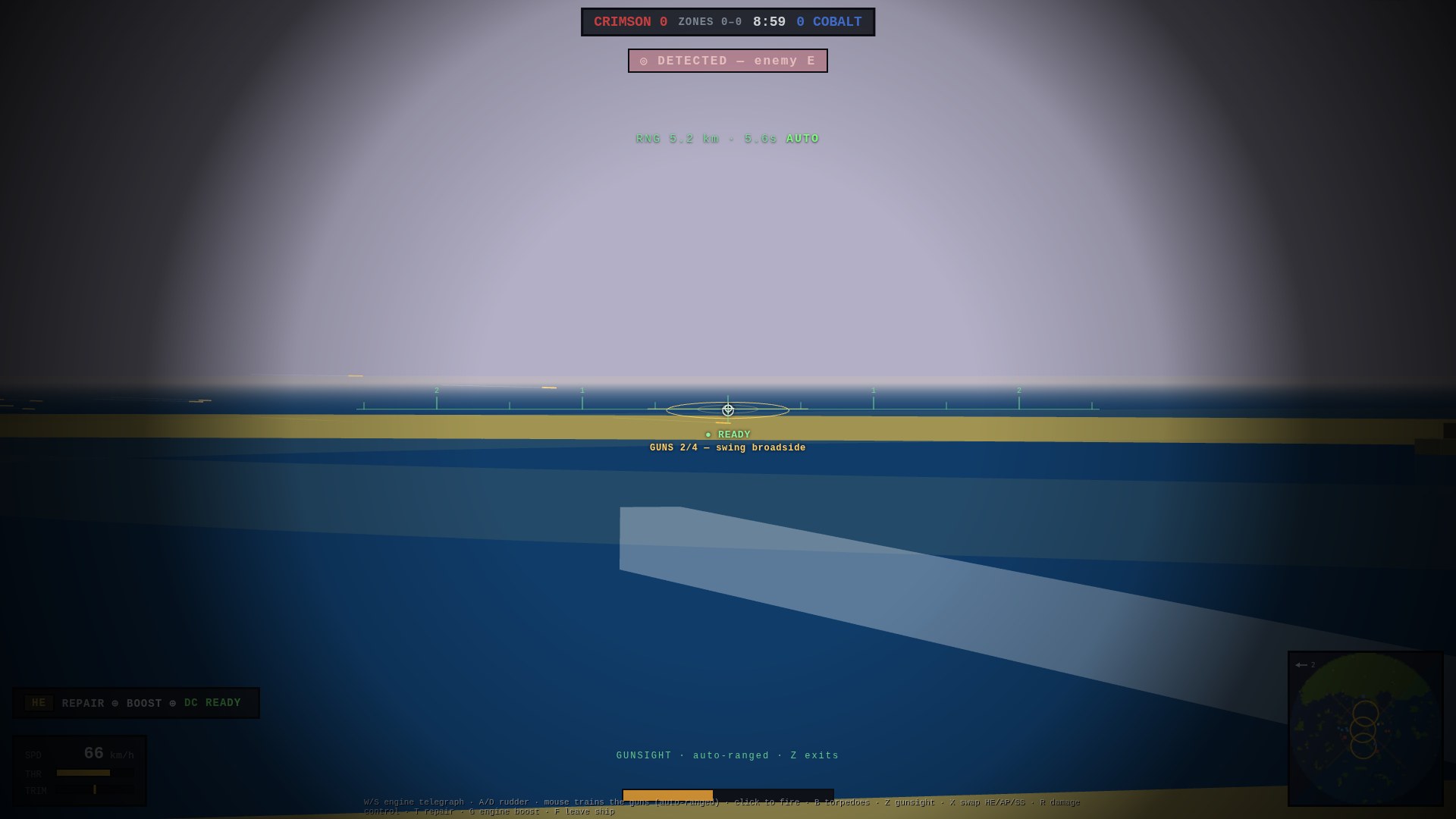
Now the ring tells the truth, and it is a slim one. Lay it on a ship and her side takes the salvo: at six kilometres a Dreadnought's ring is about twenty metres wide, and her nine heavy shells come down inside it. The same cruiser at eight kilometres now takes nearly every shell.
So leading is the whole skill, the way it is on a flak gun. At eight kilometres your shells hang nine or ten seconds in the air, and a Tachi at flank speed covers two hundred metres in that time. Read her wake, lay the ring where she will be, fire. Miss now and it was your lead. Hit and it was you.
A few things still decide a salvo:
- The ring is long and slim. On a flat naval arc the smallest touch of elevation carries a shell a long way past or short, so a salvo spreads down the line of fire far more than across it. A ship broadside to you soaks up the whole pattern; one bow-on, slim as she is, can still slip between the shells at long range. Angle your own bow and you make yourself that hard.
- Heavier guns throw tighter patterns. The Dreadnought's big guns are the most precise at sea, a Bastion's and a Tachi's spread a little wider, and the Tempest's autoloaders trade a looser pattern for a storm of shells.
- Islands still count. Your gun deck sits lower than your gunsight, and a hill close off your bow can take a salvo the sight sees over.
One old gremlin is gone too: now and then a shell laid dead on a destroyer lying broadside to you passed straight through her without a scratch. It lands now.
The tank guns shoot straight
On the Brick Steppe the Paladin's dart now goes where the crosshair is, all the way out to the edge of its range. Lay it on a tank's nose three kilometres off and it strikes her; before, nearly half the darts flew past a target that narrow. Closer in the gun was already good, and now it is sure.
The Jackal got the same treatment. Halt the gun truck and lay the crosshair, and its recoilless round strikes a tank's flank at two kilometres every time; before, it was little better than a coin toss at a kilometre and a half. On the move it still sprays, because its gun isn't stabilized the way the Paladin's is. Halt, shoot, scoot.
The crews still miss like crews
The guns you don't crew — the rest of the flak line, the convoy escorts, the Bofors decks of every Tachi, Bastion, Dreadnought and Tempest, your own ship's included — are worked by their own gun crews, and those crews miss the way real ones did: the range misjudged, the lead cranked in a touch wrong, the course they assumed for a plane that has already turned. They miss just as often as they did before, so the sky over the flak line is no deadlier than it was. The reaper isn't coming back.
The bot pilots are the same. Their eye on the gunsight wanders just as much as it always did, so they hit you, and each other, no harder than before. So do the bot captains: an enemy battle line's salvos still land as the same scattered hail they always did, and an AI tank crew, in a Paladin or a Jackal, still misses the way it did. Only your own guns got better.
What changed is how everyone else's misses look. The old fire sprayed like a shotgun, a cone of tracers with no shape to it. Now a crew's stream holds together and walks: it hunts along behind you, corrects, overshoots, comes back. A long burst from a Whirlwind sweeps across the sky like a hose. That's something a pilot can read. When the stream stops walking and starts closing, break.